Why Guyad Deserves a Spot in Your Handmade Font Collection
I was sitting at my kitchen table three weeks before Valentine’s Day, staring at a stack of kraft paper tags and a half-empty bottle of matte adhesive. The candle I had poured the night before had set beautifully, a warm vanilla bourbon scent that deserved packaging as thoughtful as its fragrance. But the label—the label needed something special. I had tried five different fonts that morning, and each one felt either too rigid or too playful. Then I opened a folder I had almost forgotten about, clicked on a file named Guyad, and something clicked.
The first test print came out of my inkjet, and I actually laughed out loud. The curves were soft without being fussy, the letterforms had a natural rhythm that felt both deliberate and effortless. I cut the label with my Silhouette, burnished it onto the amber glass jar, and held it up to the light. That was the moment I understood what a truly well-crafted casual script font can do for a handmade product. It didn’t just label the candle—it introduced it.
A Font That Feels Like a Real Hand
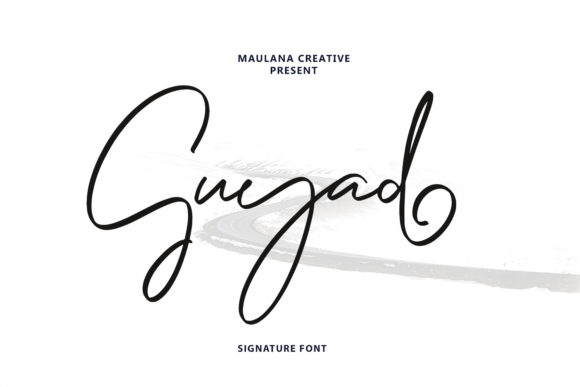
Guyad belongs to the Script Amp category, and if you are familiar with script fonts, you know that category can be hit or miss. Some scripts are so ornate they become illegible at small sizes. Others are so casual they feel careless. Guyad sits in a sweet spot that is hard to find. It has the warmth of hand-lettering without the uneven baseline that makes cutting vinyl a nightmare. Each character feels connected to the next in a way that mimics natural handwriting, but the spacing is consistent enough that you don’t spend hours kerning in your design software.
The visual personality of this typeface is approachable and slightly nostalgic. It reminds me of the kind of handwriting you see on a vintage bakery sign or a farmhouse chalkboard, but cleaned up and refined for modern product packaging. There is a gentle bounce to the lowercase letters, a slight lift on the ascenders, and a confident finish on every terminal. It is the kind of font that makes a simple word like “welcome” or “handmade” feel like a small piece of art.
For someone who makes products by hand, choosing a font is not just about aesthetics. It is about translating the care you put into your craft into a visual language your customers can read at a glance. Guyad does that translation beautifully.
Labels That Tell a Story Before the Scent Does
Let me walk you through how I used Guyad across a small batch of products last month. I started with candle labels, as I mentioned, but the font quickly found its way onto soap wraps, a limited run of wedding welcome signs, and a set of greeting cards I was testing for spring.
For the candles, I set the scent name in Guyad at a 24-point size and paired it with a clean sans serif font for the ingredients and weight. That combination—a casual script for the hero text and a neutral sans for the details—created a hierarchy that felt professional but not cold. The label read “Vanilla Bourbon” in that soft, flowing hand, and suddenly the candle felt like something you would find in a boutique rather than a market stall.
On the soap wraps, I used Guyad for the product name and a smaller handwritten font for a short ingredient list. The contrast worked because the two scripts had different personalities but similar weight. Guyad carried the main message, and the supporting script added texture without competing for attention. I printed everything on matte sticker paper, let the ink dry fully, and then cut each label by hand with scissors. The curves of the letters guided my cuts naturally, which is something I had never experienced with a more geometric font.
Wedding Stationery and the Art of First Impressions
A friend asked me to help with her wedding invitation suite last summer, and looking back, I wish I had discovered Guyad then. For the save-the-dates, I used a bold display serif font for the couple’s names and set the event details in Guyad. The script softened the overall look without making it feel informal. The word “together” in particular flowed beautifully in Guyad—the letters connected like a real hand had written them on linen paper.
If you design wedding stationery, you know that script fonts are nearly mandatory for certain elements. The couple’s names, the date, the words “love” and “celebration.” But not every script font handles the uppercase-lowercase transition well. Guyad does. The capital letters have enough presence to start a word with confidence, and the lowercase letters follow naturally. I tested it with names like Sarah and Michael, and both looked balanced. Longer words like “celebration” retained their readability even at smaller point sizes, which is not always true for casual scripts.
Printable Wall Art and Digital Downloads
For makers who sell digital printables, Guyad is a strong candidate for your product line. I created a set of farmhouse-style wall art prints last week, each featuring a short quote centered on an 8x10 canvas. The font handled phrases like “Gather here with grateful hearts” and “Let love grow” with an organic flow that felt handmade rather than machine-typed. I paired it with a simple serif font for the attribution line, and the overall piece looked like something you would frame and hang in a breakfast nook.
When you sell digital downloads, your customers are often purchasing the feeling of your design as much as the design itself. A font like Guyad adds perceived value because it looks custom. Buyers see that flowing script and assume hours of hand-lettering went into the piece. In reality, you selected a quality typeface and arranged it thoughtfully, but the result is the same—a product that feels premium and intentional.
Cutting Vinyl and the Practical Side of a Script Font
If you use a Cricut or Silhouette for your products, you already know that script fonts can be tricky. Thin connectors break, lowercase loops get lost, and letters that overlap too much create weeding nightmares. I tested Guyad in vinyl for a small batch of tote bags and a wooden sign, and the results were encouraging.
For the tote bags, I cut the word “handmade” in Guyad at about 4 inches tall using permanent vinyl. The letters weeded cleanly because the font’s connectors are thick enough to hold their shape but not so thick that they crowd the negative space. The loop on the lowercase h and the tail of the d stayed intact. I applied transfer tape, burnished well, and lifted the design in one piece. No broken pieces, no frustrating moments with tweezers.
The wooden sign was a gift for a friend’s new bakery. I cut the shop name in Guyad at 6 inches tall using adhesive vinyl on painted wood. The script read clearly from across the room, which is important for business signage. The casual feel of the letters matched the bakery’s rustic interior, and my friend said it looked like it had been hand-painted by a local artist. That kind of reaction is exactly what you hope for when you choose a font for a physical product.
Packaging, Tags, and the Brand Consistency Question
For handmade sellers who sell across multiple product categories, maintaining brand consistency can be challenging. You want your candles, soap, and stationery to feel like they belong to the same family, but each product has different size constraints and design needs. Guyad can serve as a unifying element across your product line. Use it for your shop name on tags, your product names on labels, and your thank-you cards tucked inside each package. Customers will start to associate that flowing script with your brand, even if they don’t consciously recognize the font.
I started adding a small thank-you card to every order last year, and I print them in batches using Guyad for the greeting and a simple sans serif font for my shop policies. The cards cost pennies to produce, but customers have mentioned them in reviews as a thoughtful touch. That is the power of a well-chosen typeface—it communicates care before the customer even opens the product.
What to Check Before You Start Selling
Before you start using Guyad for products you sell, take a moment to review the included styles and the commercial license. This font comes with alternates and ligatures that add variety to your designs. If you are using design software that supports OpenType features, you can access those extras and make each piece feel unique. The file formats typically include OTF and TTF, both of which work well for print and cut applications.
Commercial licensing is straightforward with most Script Amp fonts, but always confirm that your intended use—whether physical products for sale, digital templates, or printables—is covered. If you are creating SVG-style designs for resale or editable templates, check the terms carefully to avoid any licensing issues down the road.
Multilingual support is another feature worth verifying, especially if you sell to international customers or create products with foreign language text. Guyad includes a solid range of accented characters, which opens up possibilities for bilingual packaging or destination wedding signage.
Pairing Guyad with Other Fonts
One of the strengths of a casual script like Guyad is how easily it pairs with other typefaces. I have used it with a clean sans serif font for product labels, as I mentioned, but it also works well with a simple serif font for a more traditional look. If you want a layered, handwritten feel, pair it with a rough handwritten font for secondary text. The contrast between the smooth script and the textured hand-lettering creates visual interest without looking chaotic.
For bold display applications like sale signs or banner headers, consider pairing Guyad with a condensed sans serif or a geometric font. The script provides the emotional connection, and the display font provides the structure. That combination is a staple of modern packaging design and editorial design, and it works because the two fonts serve different roles without competing.
A Font That Earns Its Place in Your Workflow
I have been making and selling handmade products for over six years, and I have cycled through dozens of fonts. Some I used once and abandoned. Others I kept coming back to for specific projects. Guyad is one of those rare typefaces that earns a permanent spot in my design folder because it works across so many applications. Candle labels, greeting cards, wedding invitations, tote bags, signs, packaging, digital downloads—it handles each format with the same natural ease.
The next time you are designing a product and the text feels off, try setting it in Guyad. Print it, cut it, hold it in your hands. You will see what I mean about that kitchen table moment when everything falls into place. A good font does not just display words. It introduces your product to the world with warmth, clarity, and a sense of purpose. Guyad does exactly that.